Call API
Getting started
Introduction
The current document describes the Call API, which allows you to make and manage calls.
You can also manage calls received through the virtual PBX. To do this, you need a unique ID for your call session, which you can obtain from the REST API notification server.
The API is based on the JSON-RPC 2.0 specification and does not support batch operations.
When a request is made to the API, HTTP/1.1 with SSL/TLS connection protection is used as the transport protocol. In this case, the following requirements must be met:
- The
Content-Typeheader must beapplication/json; charset=UTF-8. - The
Content-Lengthheader must specify the correct message length, as required by the HTTP/1.1 specification.
Conventions
The following conventions are used:
- Empty fields are always returned with a
nullvalue. For an array, an empty array is returned; for an object, an empty object is returned. - All fields related to time and date are transferred according to ISO 8601, in the following format:
YYYY-MM-DDThh:mm:ssZ. - Requests to the API are always made using the
POSTmethod. - All keys in requests/responses, in the JSON data structure, and in method names use
snake_casestyle - with words separated by underscores. - Data is returned only in JSON format, according to the RFC 7159 specification.
- Data encoding: UTF-8.
Authorizing IP address
By default, access to the API is denied for everyone. To enable requests, you need to add the host IP address used to make a request to the whitelist. This can be done in your client area "Administrator" -> "Account" -> "Security", tab "API".
Call API users
You can choose a set of authorization rules in the form of a checkbox Access to Call API. Go to your client area "Administrator" -> "User management" -> click the User you want to grant Call API access to and enable the Call API Basic set component.
This can only be done by the administrator.
Access by login and password
Authentication by login and password. The reply contains a key to access the Call API.
The default duration of a session is 1 hour.
Access by key
To enable access by key, you need to go to your user settings and tick the "Access by key" box. Be careful: you can see and copy the key only at the moment it is generated. After you have saved the settings, the key is only available in the application's code or another place where you store it.
Depending on your settings, keys can be temporary or permanent.
Statistics and reports
You can access all requests to the API in your client area "Reports" -> "Tech Log" -> "Requests to API". This excludes requests with errors:
- If a JSON or request-structure error is returned - the mnemonic
parse_errororinvalid_request. - If an error caused by a call to a non-existent method is returned - the mnemonic
method_not_found. - If an authentication error is returned -
access_token_blocked,access_token_invalid,access_token_expired,auth_error. - If an error caused by a request from a non-authorized IP is returned - the mnemonic
ip_not_whitelisted.
You can find detailed information about any call in "Reports" -> "Inquiries" -> "Calls" using the "Call session ID" filter.
If there is no "Call session ID" option in your filters, you need to add it to the available report columns.
Managing security settings for calls
You can manage security settings for your calls (mobile, national, international) in your client area "Account" -> "Security", tab "API".
By default, international calls are not permitted. Other call types are allowed.
Permissions for calls are categorized by Call API components (refer to Components).
Components
| Client-facing name | List of methods | Description |
|---|---|---|
| Call API Basic set | start.employee_call, start.vnumber_call, start.simple_call, login.user, logout.user, release.call | Basic set for Call API |
| Call API Call management | hold.call, unhold.call, make.call, disconnect.leg, tag.call, record.call, add.coach, list.calls, send.dtmf, block.contact, restore.talk, transfer.talk, list.talk_options, call.talk_option | A set that allows you to manage calls. |
| Call API Informer calls | start.informer_call | A set that allows you to call clients and play a TTS or another preset media file. Once your informer message is complete, the call ends automatically. |
| Call API Call scenario | start.scenario_call | A set that allows you to call clients using a virtual number and a set of scenarios. |
Return data format
| Format | MIME Type |
|---|---|
| JSON | application/json |
By default, the JSON format is used. The
Acceptheader is ignored.
Base URL to access the API
The base URI to access the API:
https://callapi.callgear.com/<version>
where
<version> is the API version (refer to Versions).
Versions
Call API supports versioning. A version is specified in the base URL as vX.Y, where X is the major version number and Y is the minor version number.
Versions should be written using a dot, such as
4.0.If a new version is released, the previous one is considered outdated. Therefore, if you send a request to an old version of the API, the
current_version_deprecatedparameter with the valuetruewill be returned in the meta parameters (refer to Meta parameters). This means that within the next couple of months the old version may become unavailable.
Example:
https://callapi.callgear.com/v4.0
The maximum number of supported versions is 2.
The support period for old versions is 2 months.
Limits and restrictions
Limits are based on a points system; that is, each method has a value measured in points.
Points are deducted only for a successful request; that is, the request is marked as successful in a request report. A request is considered successful if the
resultis returned with the statussuccess = trueor with a call session ID.Limits are tied to the
Call API Basic setcomponent (refer to Components) and are applied depending on a method's point value.Data about limits is returned in every reply in the meta parameters (refer to Meta parameters), except when limits are not applied:
- If JSON or request-structure errors are returned - the mnemonic
parse_errororinvalid_request.- If an error caused by a call to a non-existent method is returned - the mnemonic
method_not_found.- If an authentication error is returned -
access_token_blocked,access_token_invalid,access_token_expired,auth_error.- If an error caused by a request from a non-authorized IP is returned - the mnemonic
ip_not_whitelisted.
Data about limits is returned in the meta parameters (refer to Meta parameters).
Expanding limits
You can manage limits in your client area "Account" -> "Rates and options".
Limit names:
- Call API points per minute;
- Call API points per day;
- TTS message length.
If you don't have any limits in your client area, you may have restrictions in your service plan. In this case you need to contact your personal manager or technical support.
Meta parameters
They are returned in response to a method call. They appear both in a successful response and in a response with an error.
The
api_versionparameter is returned only for versions that aredeprecated.
Description of parameters:
| Parameter name | Description |
|---|---|
day_limit |
Current limit - points per day |
day_remaining |
Points left until the daily limit |
day_reset |
Seconds until the daily limit is reset |
minute_limit |
Current limit - points per minute |
minute_remaining |
Points left until the minute limit |
minute_reset |
Seconds until the minute limit is reset |
current_version_deprecated |
Indication that an old version may become unavailable within 2 months |
current_version |
Current version |
latest_version |
Latest version |
JSON structure:
"metadata": {
  "api_version": {
    "current_version_deprecated": "boolean",
    "current_version": "string",
    "latest_version": "string"
  },
  "limits": {
    "day_limit": "number",
    "day_remaining": "number",
    "day_reset": "number",
    "minute_limit": "number",
    "minute_remaining": "number",
    "minute_reset": "number"
  }
}
General
Fields common for all methods
| Title | Type | Required | Valid value | Description |
|---|---|---|---|---|
| id | string or number | yes | Unique ID of the request to the API. Is not communicated in notifications. It appears only in the |
|
| method | string | yes | The method being called (refer to the Methods list) | |
| jsonrpc | string | yes | 2.0 | JSON-RPC specification number |
| params | object | yes | Contains the body of the request to the API. The body changes depending on the method. |
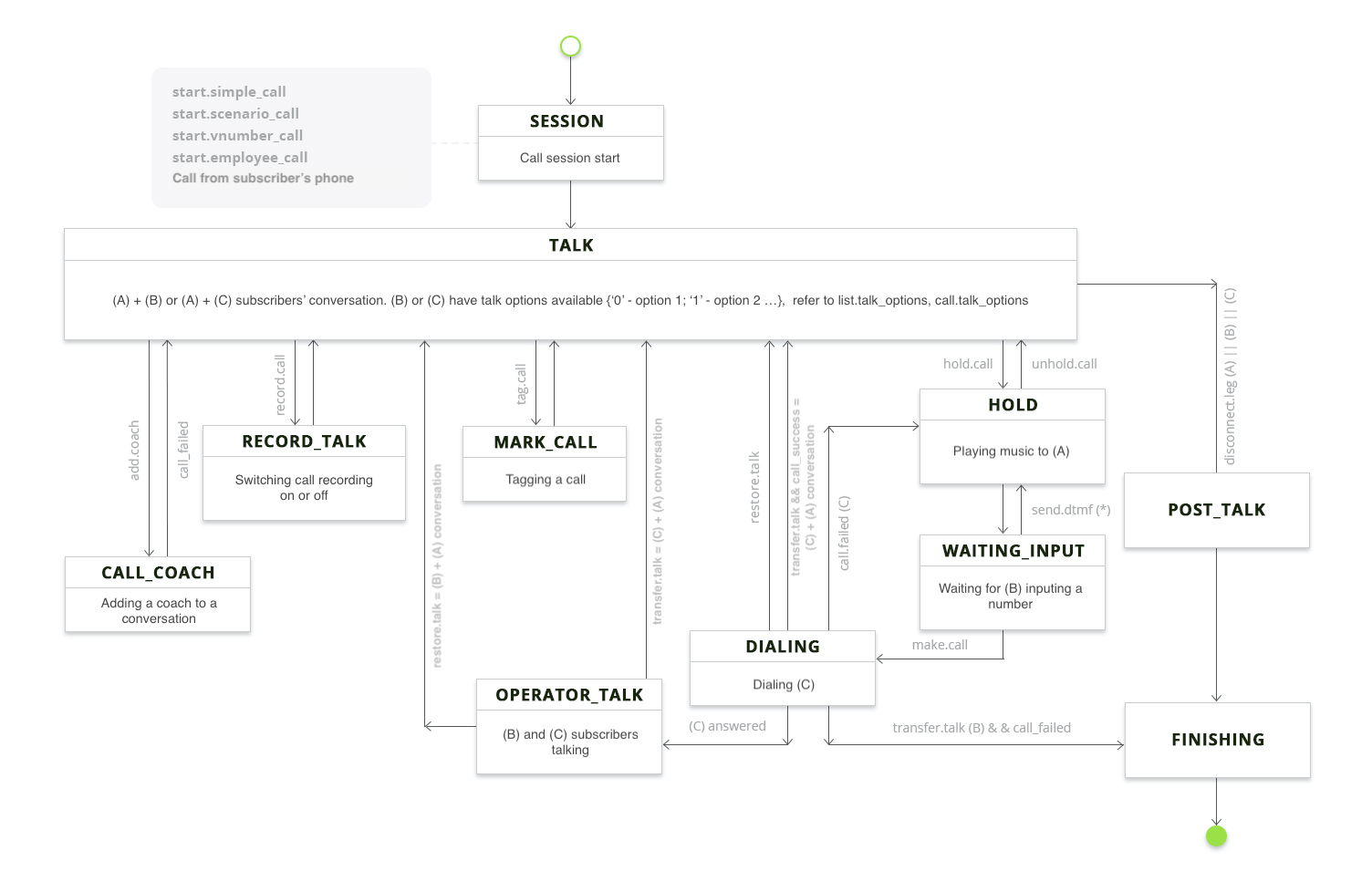
Call state diagram
Authentication
| Method | Description |
|---|---|
| "login.user" | Login |
| "logout.user" | Logout |
Group of methods to make calls
| Method | Description |
|---|---|
| "start.employee_call" | The method implements a direct call to an employee and does not use any call flow (scenario). |
| "start.scenario_call" | The method allows you to make calls according to a customized scenario. To use the method, you only need a virtual phone number and a scenario. |
| "start.vnumber_call" | Call to a virtual number. |
| "start.informer_call" | Informer call with an option to play a media file for a subscriber or transmit a text message. After the message is played, the call ends automatically. |
| "start.simple_call" | Call to any number except your own virtual numbers. This is not a call from an employee to any number. |
Group of methods for call management
| Method | Description |
|---|---|
| "make.call" | Make a call for transfer or consulting. |
| "transfer.talk" | The method allows transferring calls to another employee or to an external number (refer to "Call state diagram"). |
| "restore.talk" | This method allows you to restore a conversation after a subscriber consulted another employee (refer to the "Call state diagram" section). |
| "hold.call" | Holding a call. |
| "unhold.call" | Unholding a call. |
| "tag.call" | Tagging an active call. |
| "disconnect.leg" | The method allows you to disconnect various legs of a call. You can access the ID for each leg via the list.calls method or a notification server. |
| "add.coach" | Adding a coach to a call. |
| "record.call" | Managing call recording. You cannot switch off the recording of a call set via your client area. |
| "block.contact" | Block a contact during a call. |
| "call.talk_option" | Calling a talk option set in the client area of your virtual PBX. |
| "send.dtmf" | Sending DTMF by an employee. The method is used when the client side has an IVR and it requires you to choose a menu option. |
| "list.talk_options" | Receiving a list of talk options set in the client area of your virtual PBX. |
| "list.calls" | Receiving a list of active calls and their participants. |
| "release.call" | Releasing a call. |
Error messages
| Parameter | Type | Required | Valid value | Description | ||
|---|---|---|---|---|---|---|
| error | object | yes | Object with error contents | |||
| code | number | Yes | Code of the error (refer to Groups of error codes) | |||
| message | string | yes | Error message (refer to List of errors common for all methods) | |||
| data | object | yes | Object with error details | |||
| mnemonic | string | yes | Unique text code of an error (refer to List of errors common for all methods; there are also errors specific to certain methods) | |||
| field | string | no |
Name of the parameter associated with the error.
|
|||
| value | string | no |
Contains information transmitted by a client without any changes. In some cases it may be absent - for example, when a required parameter is not filled in. |
|||
| params | object | no | Map of parameter substitutions for a template with error text. That is, it contains values that can change dynamically, such as limits or TTS message length. The value from this parameter can be used in error messages in the interface built on top of Call API (operator's workspace). | |||
| extended_helper | string | no | Link to a page with more information about the error and possible solutions | |||
Example of an error
{
  "jsonrpc": "2.0",
  "id": null,
  "error": {
    "code": -32602,
    "message": "Data supplied is of wrong type",
    "data": {
      "mnemonic": "data_type_error",
      "field": "contact",
      "value": "number",
      "params": {
        "object": null
      },
      "extended_helper": null
    }
  }
}
Groups of error codes
| Code of error | Description |
|---|---|
| -32700 | Errors related to JSON validation |
| -32600 | Errors related to validating parameters of a request - id, jsonrpc |
| -32601 | Errors related to methods |
| -32602 | Errors related to validating parameters in a called method |
| -32603 | Internal errors of the JSON-RPC server. If an error occurs, you need to contact technical support and provide the request that caused the error, as well as the time of the request. |
| -32001 | Authentication errors and errors with keys |
| -32002 | Errors related to: security rules prohibit calls in the given direction (refer to Security rules) and blacklist. |
| -32003 | Errors with access rights - IP address is not in the whitelist, a user does not have access rights |
| -32004 | Errors related to the wrong order of called methods |
| -32007 | Errors related to the virtual number |
| -32008 | Errors related to components |
| -32009 | Errors related to an account. If an error occurs, you need to contact technical support and provide the request that caused the error, as well as the time of the request. |
| -32029 | Errors related to limits |
| -32099 | Errors related to support for various JSON-RPC 2.0 specification features - batch operations, Notifications |
List of errors common for all methods
| Text of message | Code | Mnemonics | Description |
|---|---|---|---|
| Invalid Request. The JSON sent is not a valid Request object | -32600 | invalid_request |
Errors related to validating parameters of a request - id, jsonrpc |
| Access token has expired | -32001 | access_token_expired |
Applies only to a permanent token. If a token expires, the error is returned |
| Access token has been blocked | -32001 | access_token_blocked |
If a permanent token is blocked, the error is returned |
| Access token is invalid | -32001 | access_token_invalid |
The error is returned if a permanent/temporary token is not found or a permanent token's lifespan is up |
| Limit per {limit_type} has been exceeded. Value of current limit per {limit_type} is {limit_max_value} | -32029 | limit_exceeded |
Limits of the service plan are exceeded (refer to Limits and restrictions) |
| Component {component_name} has been disabled | -32008 | component_disabled |
|
| Your IP {ip} is not whitelisted | -32003 | ip_not_whitelisted |
IP address of a request is not in the whitelist (refer to client area "Account" -> "Call API" tab "IP addresses") |
| Login or password is wrong | -32001 | auth_error |
Incorrect login or password |
| Your account has been disabled, contact the support service | -32009 | account_inactive |
Account blocked. If an error occurs, you should contact technical support and provide the request that caused the error, as well as the time of the request. |
| Call session not found | -32602 | call_session_not_found |
Session ID not found |
| Internal error, contact the support service | -32603 | internal_error |
If an error occurs, you should contact technical support and provide the request that caused the error, as well as the time of the request. |
| Data supplied is of wrong type | -32602 | data_type_error |
For example, if a string is expected but an int is received |
| The method does not exist / is not available | -32601 | method_not_found |
Called method is not included in the specification (refer to List of methods) |
| Permission denied | -32003 | forbidden |
No access rights, or access to the method or API, or the action, is forbidden |
| Invalid JSON was received by the server. | -32700 | parse_error |
Invalid JSON |
| Batch operations not supported | -32099 | batch_operations_not_supported |
Batch operations are not supported (refer to JSON-RPC 2.0) |
| Notifications not supported | -32099 | notifications_not_supported |
Notifications are not supported (refer to JSON-RPC 2.0) |
| The required parameter has been missing | -32602 | required_parameter_missed |
The required parameter is missing |
| Invalid parameter value | -32602 | invalid_parameter_value |
Returns in all cases when an incorrect parameter value has been transmitted, or it does not comply with the required input format |
| Unexpected method parameter(s) | -32602 | unexpected_parameters |
If parameters that are not mentioned in the JSON method structure have been given in params |